

.png?fit=max&auto=format&n=7dd5Z8Ya3mqstw6Q&q=85&s=b3d756021200b0ef7fb73322f1fbe927)
This approach will allow us not only to learn historical facts, but to feel what life was like at that time. The creation of the Character Profile is divided into several stages:
Extraction of Historical Data
.png?fit=max&auto=format&n=7dd5Z8Ya3mqstw6Q&q=85&s=ce8f8a26265dc2f7715043b9dd824289)
For this:
- Source: The student must extract historical data from the official textbook or from the indicated reference material.
- Format: The data should be filled in a historical data table.
- Objective: Ensure that all subsequent work is built on real, verified, and coherent information.
Generation of Historical Context
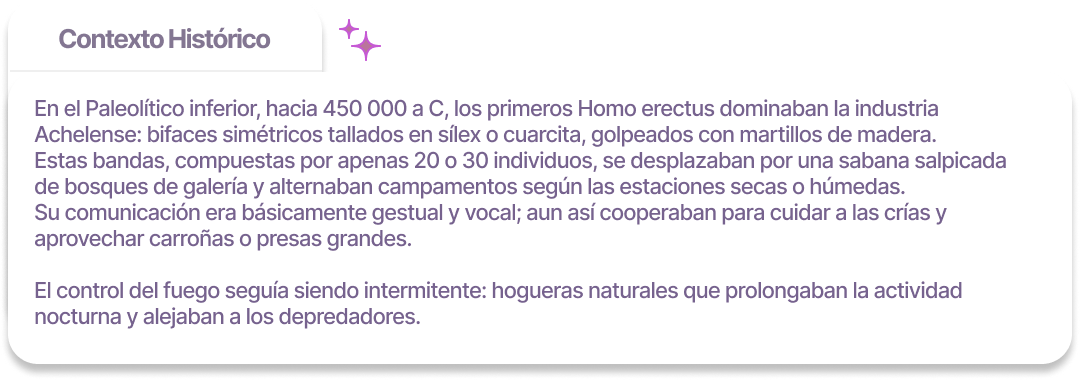
- We will start using Artificial Intelligence to generate an initial narrative historical context.
- Activity: We will learn to prompt correctly: sending the historical data to the AI to generate a text that places our character in their world.
- Verification:
- The student must review the generated historical context.
- Compare the text with the Historical Data Table.
- Detect and correct anachronisms or errors through new instructions (re-prompting) or manual corrections.
- The process will be repeated until a solid and consistent historical context is obtained.
Creation of Character Profile

- The character will be brought to life through AI:
- Name appropriate to the time period and culture.
- Brief description defining their essential characteristics.
- Location based on a real archaeological site from the era.
- Age consistent with the assigned social or professional role.
- Species if applicable (for example, Homo sapiens, Homo neanderthalensis, etc., in prehistoric times).
- Role or occupation, according to both the era and their age (e.g.: apprentice, hunter, healer, scribe).
Creation of Personal Narrative
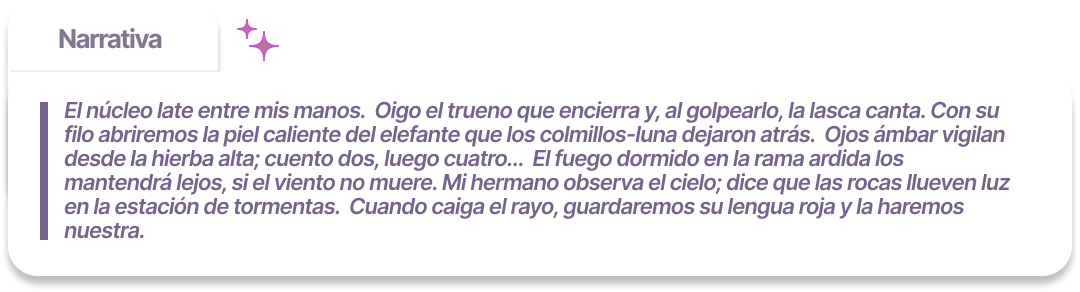
- The student will use AI to generate a first-person narrative: the character will tell a fragment of their life.
- Narrative rules:
- Literary licenses will be allowed to make the story attractive.
- However, all historical data must be correct.
- Each error found in the generated text must be corrected.
Quality Control
- Students should note each detected error in an Error Table.
- This table will be used later to analyze the reliability of AI-generated content and to develop critical thinking.
- Access the Error Table template here